


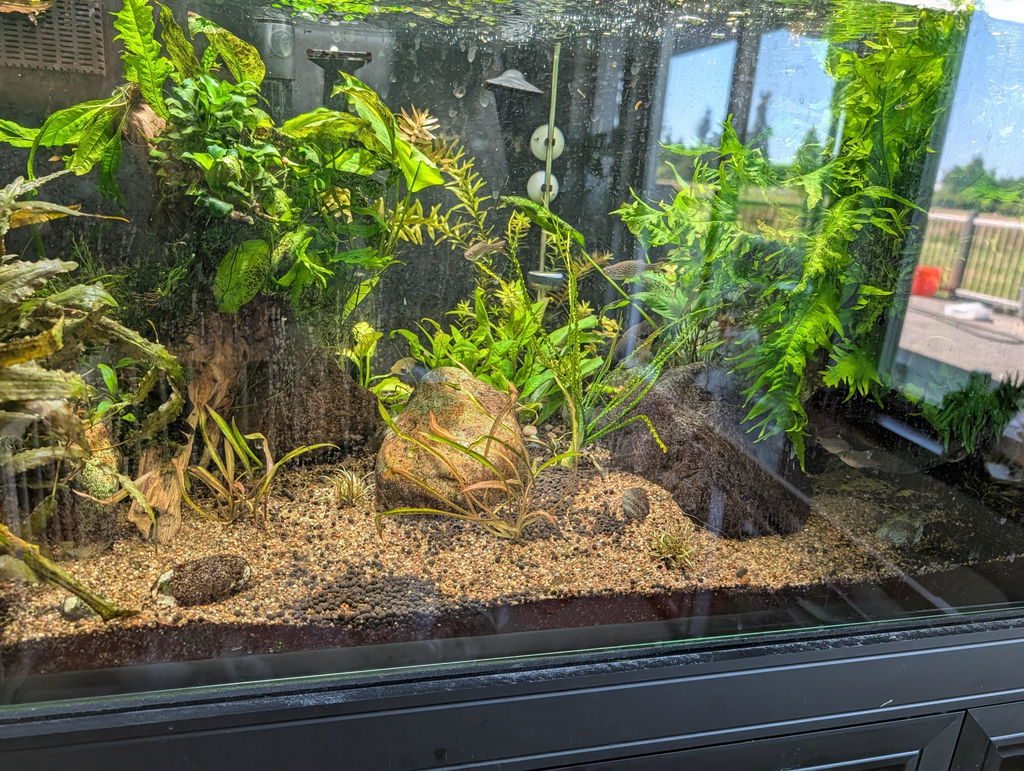
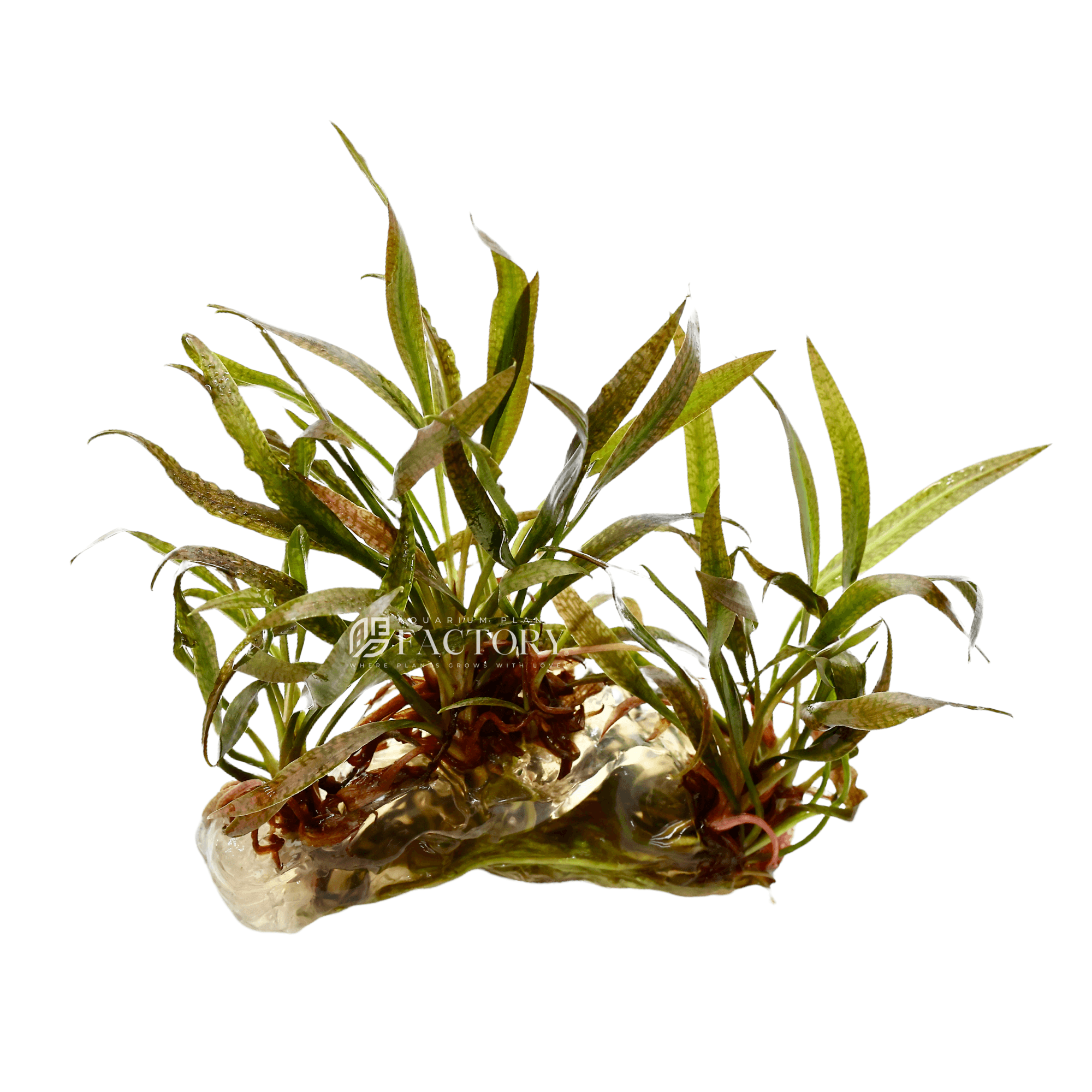
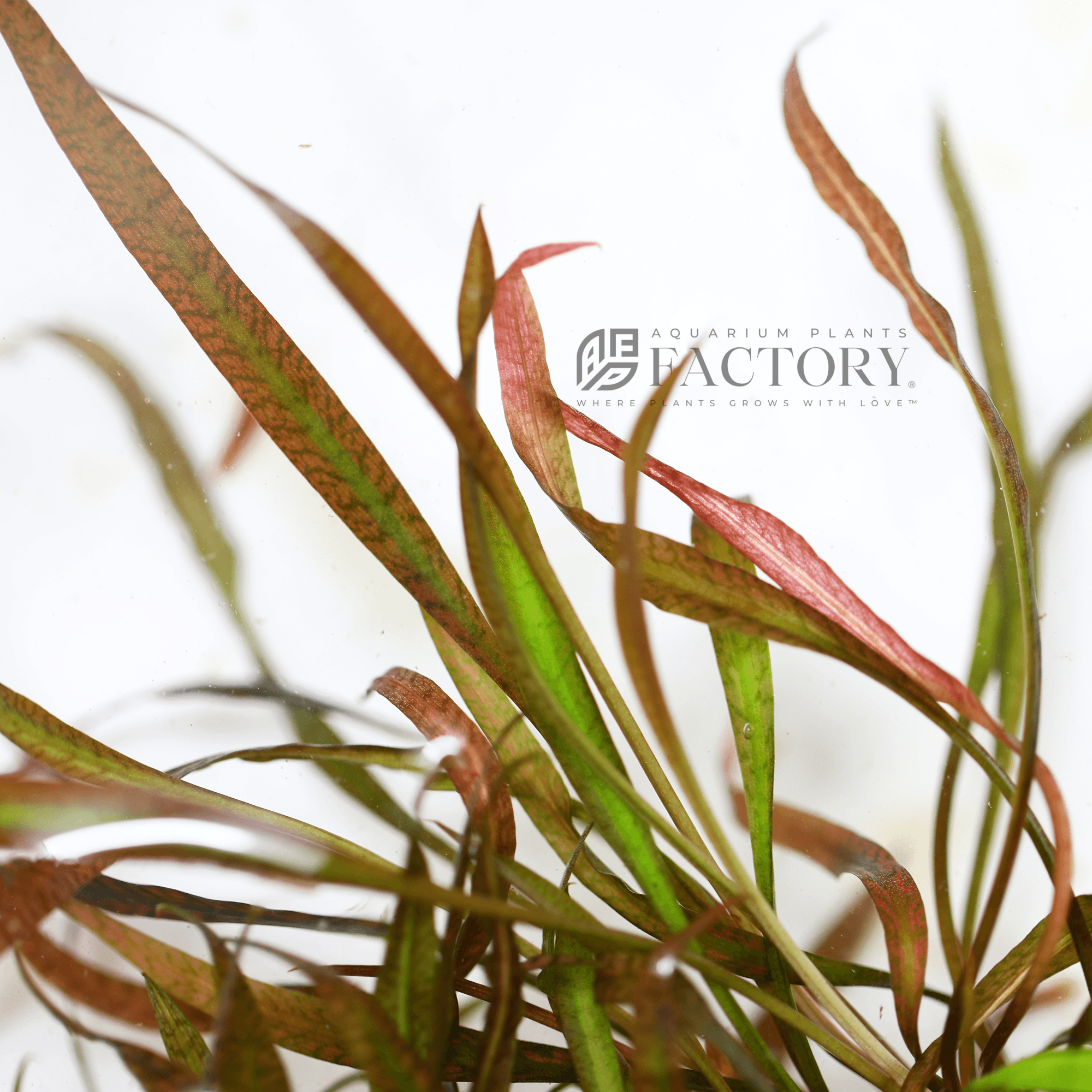
Long spiral leaves, striped like a tiger. Cryptocoryne spiralis 'Tiger' grows narrow blades that twist along their length and carry dark banding across bronze to reddish-brown — a Crypt that behaves like a background grass rather than a rosette. Native to India. This is the sterile Vitro Culture® format.
What You’ll Receive
- 1 sealed Vitro Culture® bag containing clean, healthy Cryptocoryne spiralis 'Tiger' plantlets. Yield approx. 3-4 clumps.
- Packaged in nutrient gel—ready to rinse and plant
Plant Profile
- Common name — Spiralis Tiger Crypt
- Scientific name — Cryptocoryne spiralis 'Tiger'
- Origin — India
- Placement — Background
- Mature height — 8–14 in
- Growth rate — Slow
Care
- Difficulty — Beginner
- Light — Low to medium
- CO₂ — Not required, though it deepens the color
- Water — 72–82°F · pH 6.5–7.5. Hard water suits it, as it does most Crypts
- Substrate — Required. Root feeder — nutrient substrate or root tabs
- Growth habit — Amphibious. Also grows emersed
- Propagation — Substrate runners
Grower’s Notes
- A Crypt for the back of the tank. Nearly every Cryptocoryne sold is a low rosette for the front. Spiralis 'Tiger' reaches 8–14 inches with narrow twisting blades, so it does background work — in low light, without CO₂, where Vallisneria and stems would need more.
- Expect melt after planting. Crypts drop their leaves on a change of conditions and rebuild from the roots over two to four weeks. Leave them alone.
- Place it once. Every move triggers another melt.
- The striping shows best against a plain background — in a busy scape the pattern disappears.
- Rinse the gel off completely before planting or it clouds water and feeds algae early on.
Want to go deeper? Read our complete Cryptocoryne Care Guide.
Notes
- Cryptocoryne species often experience "melting" when adjusting to new conditions. This is normal. Ensure stable lighting and parameters, and the plant will regrow once established.
- Never release aquarium plants into natural waterways.
At a glance
- Free shipping on orders of $150 or more (after discounts) within the contiguous United States, by USPS.
- Free thermal protection is included with every shipment, all year round.
- Processing: most orders leave us within 1 to 2 business days. Tracking is emailed when your order ships.
- USPS (2 to 5 business days) ships Monday through Saturday.
- UPS 2nd Day Air® ships Monday through Wednesday. Order by Tuesday at 6:00 AM Pacific Time for same-week delivery.
- UPS Next Day Air® ships Monday through Thursday. Order by Wednesday at 6:00 AM Pacific Time for same-week delivery.
- Alaska, Hawaii, Puerto Rico, Guam, the U.S. Virgin Islands and military addresses ship by USPS at a flat rate shown at checkout.
- Weather holds: during extreme heat or cold we may hold live orders until it's safe to ship.
- We ship within the United States only.
Please bring live plants indoors and unpack them the day they arrive. Every live order is covered by our 24-Hour Live Arrival Guarantee.
The complete rules, including lost packages and address issues, are in our Shipping Policy. If anything conflicts, that policy applies.
Every live order is backed by our 24-Hour Live Arrival Guarantee. If a plant arrives dead, we'll make it right.
How it works
- Tell us within 24 hours of the delivery time on your tracking.
- Send photos of the affected items in their original, unopened packaging, plus a photo of the shipping label, to hello@aquariumplantsfactory.com with your order number.
- We'll make it right with a replacement, store credit or refund for the affected item.
Good to know
- Some melting or yellowing as plants adjust from greenhouse to aquarium life is normal. They regrow from healthy roots and rhizomes.
- Please bring your package indoors and unpack it the day it arrives.
- Free promotional items and shipping charges are not covered.
The complete rules, including what's covered and what voids the guarantee, are in our Returns, Refunds & Live Arrival Guarantee. If anything conflicts, that policy applies.
Please review your state's regulations on restricted plants, as we are committed to not shipping plants that are restricted in your area. Do not release any plants into the wild or waterways, as this can harm local ecosystems by introducing invasive species.
Your cooperation in protecting the environment is appreciated. For continuously updated information, refer to the USDA State Noxious Weed list here.
Thank you for your responsible commitment to environmental preservation.
G
Biggest vitro cultures I've ever gotten before. Came with 4-5 good sized plants, and looked healthy upon arrival. They already show the cool tiger pattern and color, and I haven't gotten any melt yet. Very cool plant and a good way to get it
J
Beautiful plants, exactly as pictured. Shipped well with no damage and acclimated to my new tank without any signs of melt.
J
By far the healthiest and best looking crypts I've ever gotten straight out of the tissue culture packaging, already growing and no signs of the dreaded crypt melt.
D
oN THE CRYPTO.....S;PIRACIS TIGER VITRO CULTURE PLANT:
My tank has about 1" gravel. It is o.k. in this?
Any feeding needed? What?
What is meant by nutrient rich substrate?
tnanks
Hi Don, 1" of gravel will work for the Cryptocoryne Spiralis Tiger, though a bit more depth (2"+) gives the roots more room to establish. No special feeding is required, but crypts do respond well to root tabs pushed near the base every 1-2 months, or a liquid fertilizer if you're running a planted tank with other species. "Nutrient rich substrate" just refers to substrates like aquasoil (e.g. ADA Amazonia, Fluval Stratum) or plain gravel/sand supplemented with root tabs, which feed nutrients directly to the roots - as opposed to inert gravel alone, which has none. Plain gravel is fine, it'll just grow a little slower without added nutrients. Also, don't be alarmed if the leaves melt after planting - this is normal "crypt melt" and it'll regrow from the base. Let us know if you have more questions!


Recommended for You





Frequently Asked Questions
- Choosing a selection results in a full page refresh.
!


