

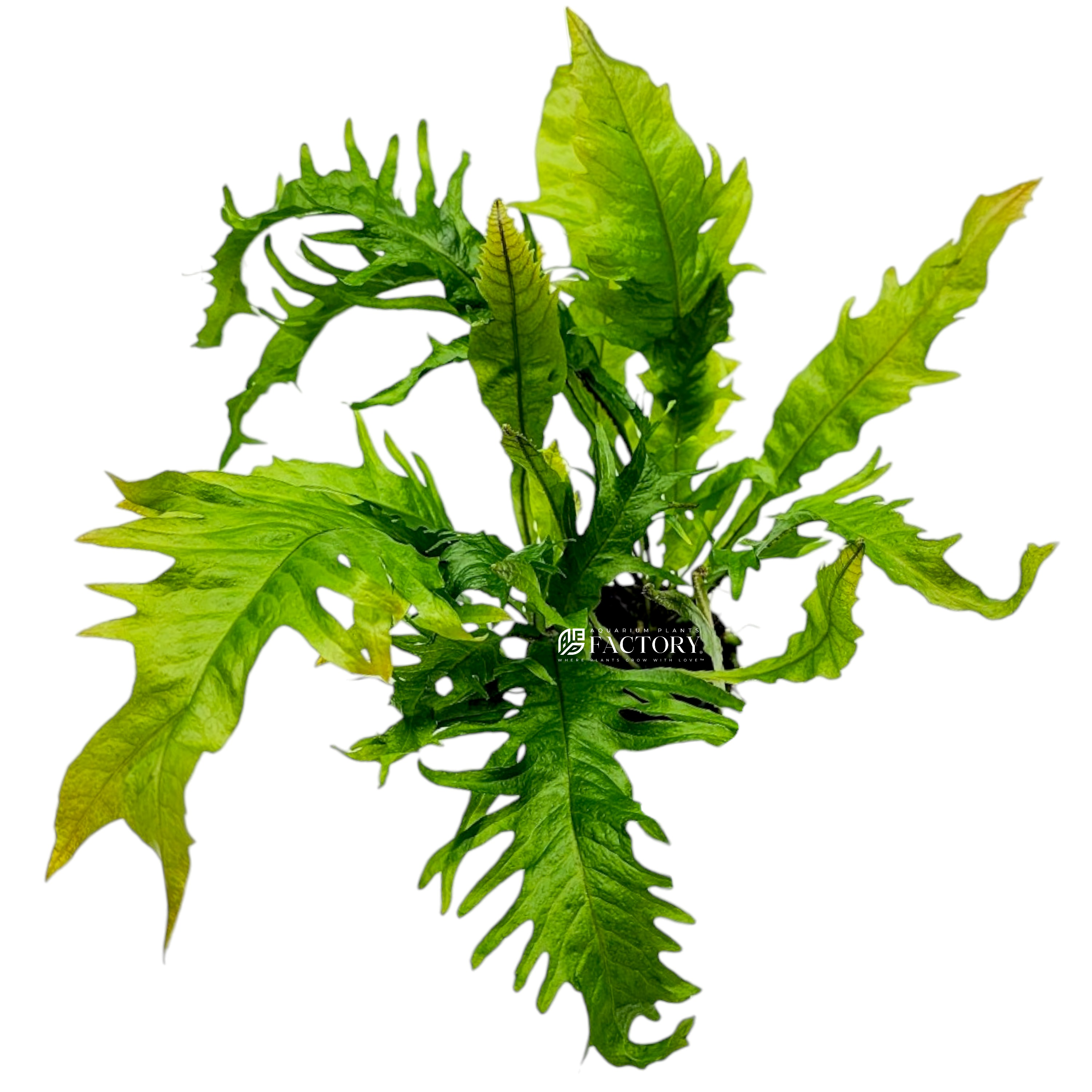


Java Fern, deeply cut. Leptochilus pteropus 'Lionfish' splits each leaf into narrow, finely dissected lobes that fan out and drift in the current like the fins the variety is named after. It is the most intricate leaf shape in the Java Fern range — and it asks for exactly as little as the plain form does.
What You’ll Receive
Fresh, healthy Leptochilus pteropus ‘Lionfish’ cultivated and prepared by Aquarium Plants Factory®, available in convenient planting formats:
- Bare-root Plants: Approximately 3+ leaf portion, loose rhizome
- Bunched Plants: Approximately 3+ leaf portion bundled with foam and plant weight
- Potted Plants: Approximately 3+ leaf portion, potted in rockwool and net pot
Plant Profile
- Common name — Lionfish Java Fern
- Scientific name — Leptochilus pteropus 'Lionfish' (syn. Microsorum pteropus)
- Placement — Midground, attached to driftwood, stone or décor
- Mature height — 6–10 in
- Growth rate — Slow
Care
- Difficulty — Beginner
- Light — Low to medium
- CO₂ — Not required
- Water — 68–82°F · pH 6.0–7.5
- Substrate — Not required. Attaches to hardscape
- Growth habit — Amphibious. Also grows emersed
- Propagation — Rhizome division, plus plantlets from mature leaves
Grower’s Notes
- Put it in the flow. The dissected leaves are built to move — in still water Lionfish just looks like a ragged Java Fern, but in a current it drifts constantly and earns its name. Place it where the filter return reaches.
- Never bury the rhizome. Tie or glue it to wood or stone; buried rhizomes rot.
- Black spots on older leaves are usually plantlets forming, not disease. Let them root, then detach and attach elsewhere.
- Intricate leaves collect detritus in low-flow corners — another reason to give it movement.
- Pair with Broad Leaf for maximum contrast: identical care, opposite silhouettes.
Want to go deeper? Read our complete Java Fern Care Guide.
Notes
- Appearance may vary slightly due to natural growth conditions. As an epiphytic plant, the rhizome should not be buried in substrate to prevent rot. Minor leaf melt may occur during transition but new growth will adapt to your aquarium.
- Never release aquarium plants into natural waterways.
Shipping Policy
At Aquarium Plants Factory, we carefully package and ship all orders to ensure plants and livestock arrive healthy and ready to thrive.
Order Processing Time
Most orders are processed within 1–2 business days after payment is received.
Orders placed on weekends or holidays will be processed on the next business day.
Orders containing out-of-stock, pre-order, or backorder items may require additional handling time.
Once your order ships, tracking information will be sent to your email.
Shipping Schedule
Live Plants
Live plant orders ship Monday through Saturday when using United States Postal Service (USPS).
Most plant-only orders ship within 1–3 business days, excluding products that are out of stock, pre-order, or backorder.
Estimated USPS delivery time is 2–5 business days, depending on your location.
UPS Express Shipping
We offer the following UPS expedited shipping options:
UPS 2-Day Air®
Estimated delivery: 2 business days
Please note that UPS 2-Day Air® is not a guaranteed service in the event of carrier delays, weather disruptions, or operational issues.
UPS Next Day Air®
Estimated delivery: 1 business day
This service is guaranteed by UPS according to their service guarantee policies.
UPS expedited orders ship Monday through Wednesday only to ensure packages arrive within the same week and avoid weekend delays.
Please note that orders require 1–2 business days of handling time before shipment.
To help ensure same-week delivery, please place UPS orders on or before Tuesday at 6:00 AM Pacific Time (PT).
Live Animals Shipping
Live animal orders ship Monday through Wednesday only.
This schedule ensures animals arrive within the same week and do not remain in transit over the weekend.
Handling time for live animal orders typically ranges from 1–5 business days, depending on:
-
Weather conditions
-
Livestock health
-
Shipping destination
Tracking information will be emailed once the order has been shipped.
Free Shipping
We offer Free Shipping on eligible orders over $150 within the contiguous United States.
Estimated delivery time for free shipping orders is 2–5 business days.
If your order contains both live plants and live animals, the shipment may be combined and the appropriate shipping rate will be shown at checkout.
Free Shipping is not available for customers located in:
-
Alaska
-
Hawaii
-
Puerto Rico
-
Guam
-
U.S. Virgin Islands
Customers in these locations must select Expedited or Express shipping options at checkout.
Delivery Time Estimates
Delivery times shown at checkout are estimates provided by the shipping carrier.
While we work hard to ship orders quickly, delivery times may vary due to factors outside of our control, including:
-
Weather conditions
-
Carrier delays
-
High shipping volumes
-
Transportation disruptions
Aquarium Plants Factory is not responsible for shipping delays caused by the carrier.
Delayed or Lost Packages
Occasionally, shipments may take longer than expected.
A package is considered lost only after 15 business days (approximately 3 weeks) from the ship date.
If a package is confirmed lost by the carrier, we may offer a 50/50 replacement, meaning:
-
Aquarium Plants Factory covers 50% of the replacement cost
-
The customer covers 50% plus shipping
Address Accuracy
Customers are responsible for providing a complete and accurate shipping address when placing an order.
Please ensure that your address is correct when using payment methods such as:
-
Credit / Debit Card
-
PayPal
-
Apple Pay
-
Google Pay
-
Amazon Pay
-
Shopify Pay
-
AliPay
Orders returned due to:
-
Incorrect address
-
Refused delivery
-
Failed delivery attempts
may not be eligible for a refund.
Order Cancellations
If you need to cancel an order, please contact us as soon as possible.
Orders can only be canceled before they have been shipped.
Once an order has been shipped, it can no longer be canceled.
Returns
Due to the sensitive nature of live goods, all sales are final.
We do not accept returns or exchanges for:
-
Live plants
-
Live animals
For any shipping questions, please contact us before placing your order.
Aquarium Plants Factory
https://www.AquariumPlantsFactory.com
What We Guarantee
24-Hour Live Arrival Guarantee — We guarantee that live plants and live aquatic animals will arrive alive. In the rare case of a Dead on Arrival (DOA), you must notify us within 24 hours of the delivery time recorded on the carrier's official tracking page. The guarantee is void after that 24-hour window, as condition can no longer be attributed to transit.
How to Submit a Claim
- Take at least 2 clear, well-lit photos of the affected items in their original, unopened, sealed packaging, plus a photo of the shipping label on the box.
- Email your photos and order number to hello@aquariumplantsfactory.com within 24 hours of delivery.
- Do not photograph plants or animals after they have been unpacked, planted, or introduced to your aquarium — once an item enters your aquarium's ecosystem, it is no longer covered.
Approved claims are resolved with a replacement, store credit, or refund at our discretion, under the terms of our Refund Policy. Each item is eligible for one replacement only — replacements are final and we cannot replace a replacement.
Conditions That Void the Guarantee
- Incorrect or incomplete shipping address (vacant address, missing apartment number, or any issue that prevents delivery)
- Packages marked "invalid address," "undeliverable," refused, or returned to sender
- Packages left unclaimed, held at a carrier facility at the customer's request, or not retrieved promptly after delivery — live goods must be brought indoors and unpacked the day they arrive
- Carrier delays, weather events, or delivery exceptions once the package has left our facility
- Shipments to freight forwarders or package-forwarding services
Providing accurate, complete shipping information and monitoring your tracking are essential to keeping your guarantee valid.
Please note: the Live Arrival Guarantee covers arrival only. We cannot guarantee ongoing success — aquarium environment, water quality, nutrients, temperature, lighting, filtration, and CO2 all affect long-term results.
What We Can't Guarantee
- Pest-free plants (potted & bare-root): Although our plants are grown in our own clean greenhouse, we cannot guarantee they are 100% free of snails, algae, or other hitchhikers. We recommend rinsing and quarantining all plants before adding them to your aquarium. Tissue culture (in vitro) plants are the exception — they are grown in sterile lab conditions, are 100% free of pests, algae, and disease, and have never been in contact with any aquarium.
- Pesticide-free plants: We use homemade, organic pest control in our greenhouse and never use copper-based pesticides, which are toxic to invertebrates such as snails, crabs, and shrimp. However, we cannot guarantee plants are entirely pesticide-free — always rinse and quarantine before use in invertebrate tanks.
- Your aquarium's success: We are not responsible for your aquarium inhabitants, including fish, shrimp, snails, and turtles. Please quarantine all plants before use.
- Growth form: Unless specified, we do not guarantee plants will grow emersed or submersed in your particular setup.
Please review your state's regulations on restricted plants, as we are committed to not shipping plants that are restricted in your area. Do not release any plants into the wild or waterways, as this can harm local ecosystems by introducing invasive species.
Your cooperation in protecting the environment is appreciated. For continuously updated information, refer to the USDA State Noxious Weed list here.
Thank you for your responsible commitment to environmental preservation.
Customers praised this unique aquarium plant for its "gorgeous" texture and "shapely leaves" that add visual interest. Most reported healthy arrivals with fast growth and plantlet production. However, some customers noted concerns about missing or insufficient rhizomes and roots upon delivery, which may affect long-term survival.
- It's gorgeous! Arrived that way and is putting out new leaves already!
- Arrived larger than expected and immediately started producing plantlets.
- Really big leaves. Very interesting looking compared to standard varieties.
G
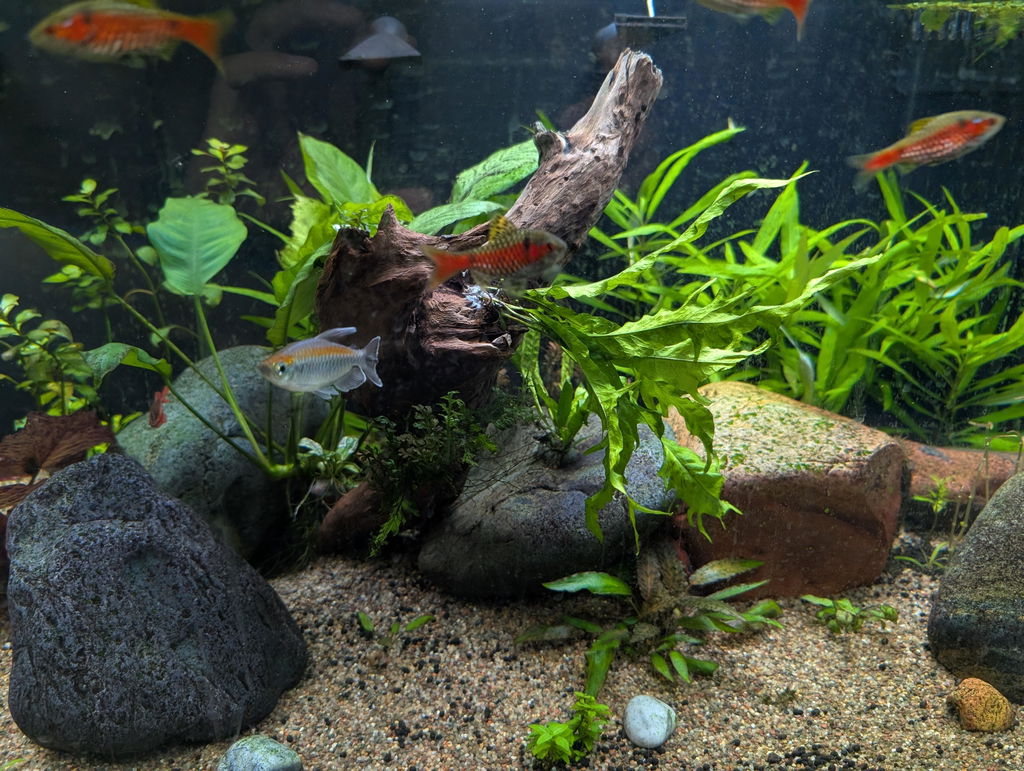
Came in good condition with really big leaves. I hadn't seen this species of Java Fern before, but it looks great and is very interesting looking compared to standard varieties. It seems to be settling into my tank well.
K
Wasn't sure exactly what to expect... Everything about this is Outstanding! Love the texture it adds to my tank!
A
My Java Fern Lionfish is gorgeous! It arrived that way and is putting out new leaves already! It’s in an outdoor patio pond with only 9 gallons of water but you wouldn’t know that by looking at it, stunning plant, great delivery and wonderful company.
C
Healthy leaves but I'm not sure this plant is long for this world. I can't see any root or a rhizome. These mightve been pups pulled too soon. I don't think I'd order this again, sadly.
C
I was so excited discovering this new Java fern species. The four fronds are beautiful, but sadly, they have next to no rhizomes or roots. One leaf has rotted, and there has been no development of the rhizome fragments. I fear I will lose this much-anticipated addition to my tank. I'm disappointed, but maybe this species is too delicate to ship.
A
Arrived larger than expected from the pictures and it immediately started producing plantlets...faster than any other Java fern I've received. Great job!
H
Lovely, shapely leaves. Adds a unique point of interest to aquarium.
N
The plants arrived healthy and beautiful! They were free from pests and healthy. Super excited to see them in my tank
K
I love this plant! Nice and healthy. Good size. A bit of a hassle picking the cotton out,
M
Healthy plants, fast shipping, can't wait to order more!
K
My plants arrived nice and green, super healthy, and in a timely manner. Fantastic service.
Recommended for You





Frequently Asked Questions
- Choosing a selection results in a full page refresh.
!