


How to Plant a Water Lily Tuber: Hardy vs Tropical
Almost every water lily that fails in its first season fails for the same reason: the crown was buried. Everything else — soil, depth, fertiliser — is recoverable. A buried crown rots, and the plant is gone before it ever puts up a pad.
The good news is that planting a lily correctly takes about ten minutes and one rule you already know by the end of this paragraph.
What arrives in the box
Every Nymphaea tuber we ship is a fresh sprouted tuber carrying one or two young leaves. That is deliberate, for two reasons.
The leaves are proof of life. A dormant tuber gives you no way of knowing whether it will wake up; a sprouted one is visibly, demonstrably viable before it ever leaves us. The young growth also travels better than mature pads, which bruise and tear.
Those young leaves may look small and they may not reach your water surface on day one. That is expected — see the planting depth section below.
Hardy and tropical tubers are planted at different angles
This is the part most guides skip, and it is the difference between a lily that establishes and one that sits and sulks. The two types grow from structurally different tubers.
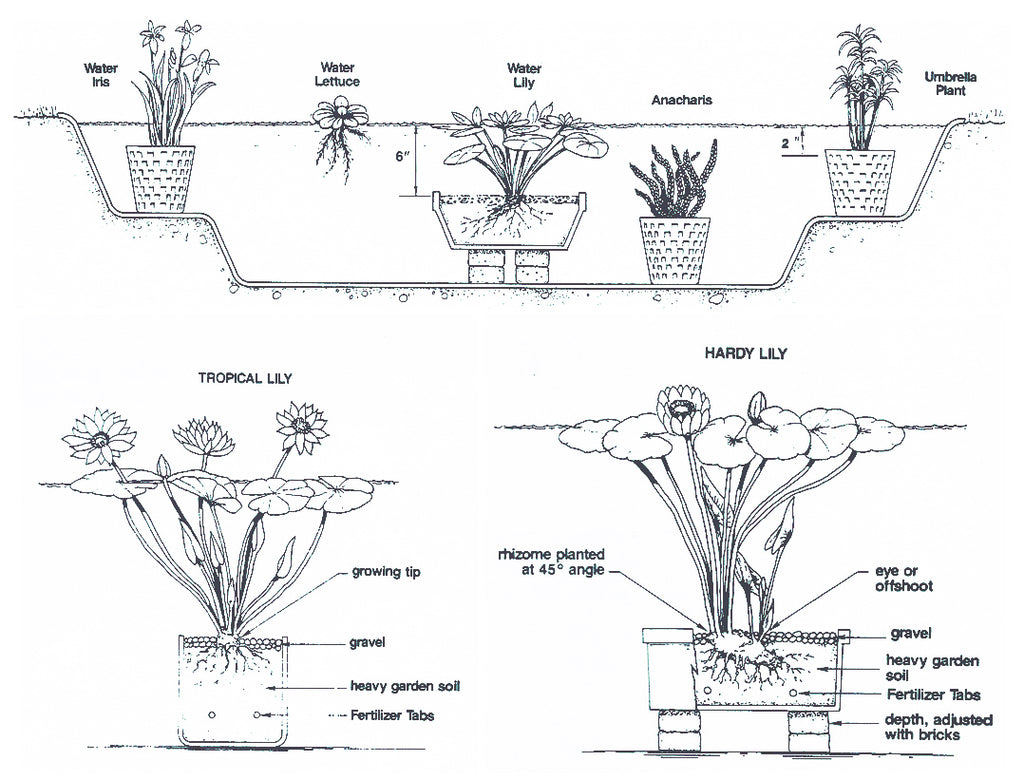
Hardy lilies grow from a horizontal rhizome — an elongated, branching structure that creeps sideways as it grows. Plant it at 45 degrees, growing tip angled upward, positioned at the edge of the pot with the tip pointing toward the centre. That angle keeps the crown clear of the soil while giving the rhizome the full width of the pot to run into.
Tropical lilies grow from a rounded, upright tuber with a single central crown. Plant it straight up, at 90 degrees, crown level with the soil surface. A tropical tuber laid at an angle is being planted like a hardy, and it will not thank you for it.
Not sure which you have? Hardy lilies flower in daylight and hold their blooms at or just above the water surface. Tropicals hold their flowers well clear of the water on tall stems, and include the night-blooming varieties. Every listing on this site states which type it is.
The crown is never buried
Whichever angle you use, the growing point — the crown, where new shoots emerge — finishes level with the soil surface. Not below it.
Soil goes up to the crown. Never over it.
If you remember nothing else from this guide, remember that.
Use a wide, shallow pot — not a deep one
Water lilies root outward, not downward. A wide shallow container suits them far better than a deep narrow one, and it is more stable on a pond shelf.
Aim for something in the range of 10 to 16 inches across and 6 to 8 inches deep for a standard lily. Dwarf varieties such as Nymphaea 'Pygmaea Helvola' are content in something considerably smaller, which is exactly why they suit tub gardens and patio containers.
A solid-sided pot is easier to manage than a mesh basket. If you use mesh, line it with hessian or landscape fabric so the soil stays where you put it.
Soil: heavy clay or loam, never potting mix
Use heavy garden loam or clay-based topsoil. Plain, heavy and dense is what you want.
Do not use commercial potting mix, compost, or anything containing peat, bark or perlite. Those are formulated to be light and to hold air, so they float straight out of the pot, cloud the water and foul the pond. This is the second most common mistake after burying the crown.
Fill the pot to roughly two thirds, position the tuber at the correct angle, then work soil in around the roots — stopping at the crown.
Cap it with gravel
Finish with about an inch of pea gravel or coarse sand across the soil surface, keeping it clear of the crown itself.
The cap holds the soil in place when you lower the pot, stops fish — koi especially — from rooting the soil out, and keeps the water clear. Skipping it is why some ponds go cloudy for a week after a new lily goes in.
Planting depth — and why the young leaves can go underwater
Here is the thing that surprises most first-time buyers: the young leaf pads can be submerged completely. They do not need to reach the surface on planting day, and you do not need to prop the pot up on bricks to get them there.
Given enough sunlight, the leaf stems extend on their own and the pads reach the surface within about a week, often sooner. This is what the plant does naturally as it establishes. Leave it be and let it work.
Set the pot at its final depth — generally 12 to 24 inches over the crown for a standard lily, and considerably less for a dwarf variety or a tub garden. If your pond is deeper than that, use a shelf, a plant stand or a stack of bricks to bring the pot up to the right level.
If a week passes and the pads still are not reaching the surface, the answer is almost always light rather than depth. Check that the pot is getting genuine direct sun and is not sitting in the shadow of a wall, a fountain or an overhanging plant.
Fertilise into the soil, not the water
Lilies are heavy feeders and they feed through their roots. Push aquatic plant fertiliser tabs into the soil near the roots — never into the open water, where they do nothing for the lily and everything for the algae.
Feed through the growing season, following the tab manufacturer's interval. Stop feeding hardy lilies as they go dormant in autumn.
Sunlight is not negotiable
Water lilies need at least six hours of direct sun to flower. In less light they will survive and produce pads, but flowering drops off or stops entirely.
A lily that grows healthy leaves and never blooms is nearly always short of sun, not short of fertiliser. Keep the pot away from fountains and waterfall outflows as well — lilies dislike moving water and turbulence on their pads.
Overwintering
Hardy lilies stay in the pond. Cut back the dying foliage in autumn and move the pot to the deepest part, below the level the pond freezes to. They go dormant and return in spring.
Tropical lilies will not survive a freeze. In climates with cold winters, lift the tuber before the first frost, clean it off and store it somewhere cool, dark and just barely moist — damp sand works — until spring. In frost-free climates, they can stay in the pond year-round.
What to expect in the first few weeks
The young leaves the tuber arrived with may yellow off and be replaced. That is normal — the plant is adjusting to your water chemistry, temperature and light, and it will shed leaves it no longer needs while it establishes a stronger set.
Remove yellowing pads and spent flowers as they appear, cutting the stem near the base. It keeps the water clean and pushes the plant's energy into new growth.
First blooms take longer than first pads and depend heavily on how much sun the pot is getting.
Quick reference
- Hardy rhizome — 45°, tip up, at the pot edge pointing inward
- Tropical tuber — 90°, straight up, crown centred
- Crown — level with the soil, never buried
- Pot — wide and shallow, 10–16 in across
- Soil — heavy clay or loam; never potting mix or compost
- Cap — 1 in pea gravel, clear of the crown
- Depth — 12–24 in over the crown; young pads may start fully submerged and will reach the surface within a week
- Fertiliser — tabs pushed into the soil, never into the water
- Sun — 6+ hours direct for flowering
Watch the planting process
Featured blog
Emersed vs. Submerged Aquarium Plants: Why the Grow Source Matters More Than the Label


October 8, 2026
Aquarium Plants Factory
Emersed vs. Submerged Aquarium Plants: Why the Grow Source Matters More Than the Label
Tip for properly changing water in a planted aquarium


October 1, 2026
Aquarium Plants Factory
Tip for properly changing water in a planted aquarium
The Lagenandra Care Guide: Cryptocoryne's Tougher Cousin


September 15, 2026
Aquarium Plants Factory
The Lagenandra Care Guide: Cryptocoryne's Tougher Cousin
Hydrocotyle Tripartita 'Mini Variegated' Care Guide


September 5, 2026
Aquarium Plants Factory
Hydrocotyle Tripartita 'Mini Variegated' Care Guide
Fertilizing Your Planted Aquarium: A Guide to Choosing the Best Fertilizer


September 1, 2026
Aquarium Plants Factory
Fertilizing Your Planted Aquarium: A Guide to Choosing the Best Fertilizer
Filtration for Planted Tanks: What Actually Matters


August 28, 2026
Aquarium Plants Factory
Filtration for Planted Tanks: What Actually Matters
- Choosing a selection results in a full page refresh.
!